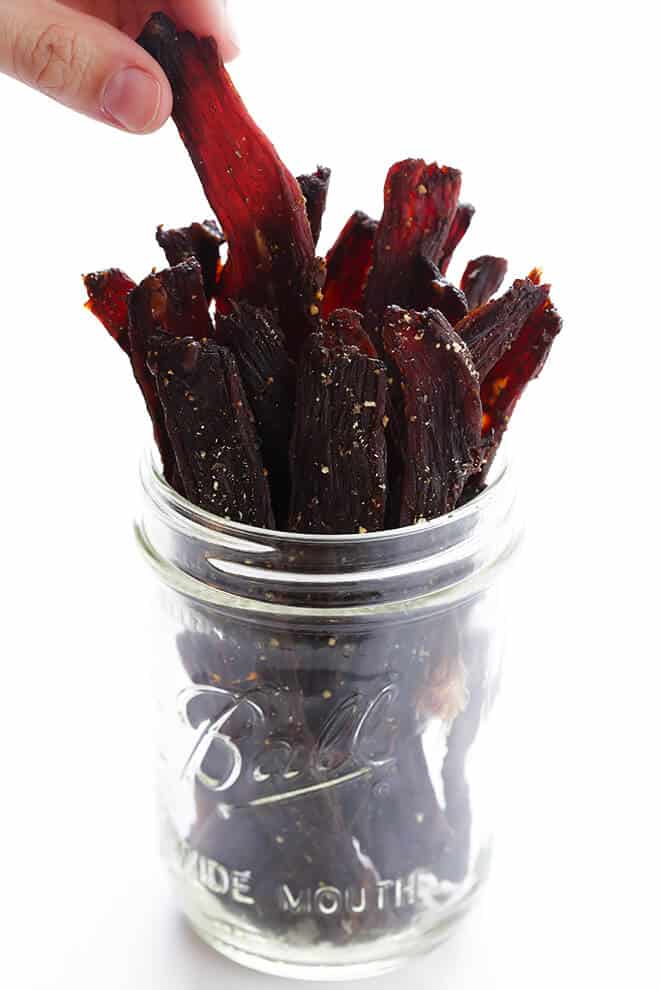
Do you remember what was on your Christmas list back in 1998?
Back then, I’m pretty sure that all of my girlfriends were asking for Abercrombie jeans, or the first-ever Harry Potter book, or the VHS of Titanic, or the latest Jewel or Matchbox 20 or Destiny’s Child or Spice Girls albums for Christmas. But me? I had one very important request of Santa that year, and I’m happy to say he (literally) delivered me my very first…dehydrator!
I mean, what 16-year-old girl doesn’t dream of having her very own dehydrator, right?! ♡
Well, having been an enormous fan of homemade beef jerky ever since I was little, I had been dreaming about having a dehydrator to make some of my own for years. It all began thanks to my great aunt Chris, who generously made batches upon batches of her famous beef jerky for our huge family holiday gatherings each year. And all thirteen of my cousins would scramble to the kitchen to see who could get the biggest handful for themselves to munch on, because her beef jerky was heavenly. And actually, I had no idea how good it was until I tried some of the store-bought stuff from a gas station years later, and could hardly believe that those weirdly sweet, sticky, and artificial-tasting strips of “beef” were the same thing. (Actually, I still feel the same way…)
So even as a teenager, I realized that if I wanted amazing beef jerky like Aunt Chris’ year-round, I was going to have to learn how to make it myself. So I called her and asked for the recipe. And 17 years, 2 dehydrators, and dozens upon dozens upon dozens of batches later, I’m still making her beef jerky recipe.
So today, I thought it was about dang time I shared about it with you too. Because in my experience…it truly is the best!
How To Make Beef Jerky | 1-Minute Video
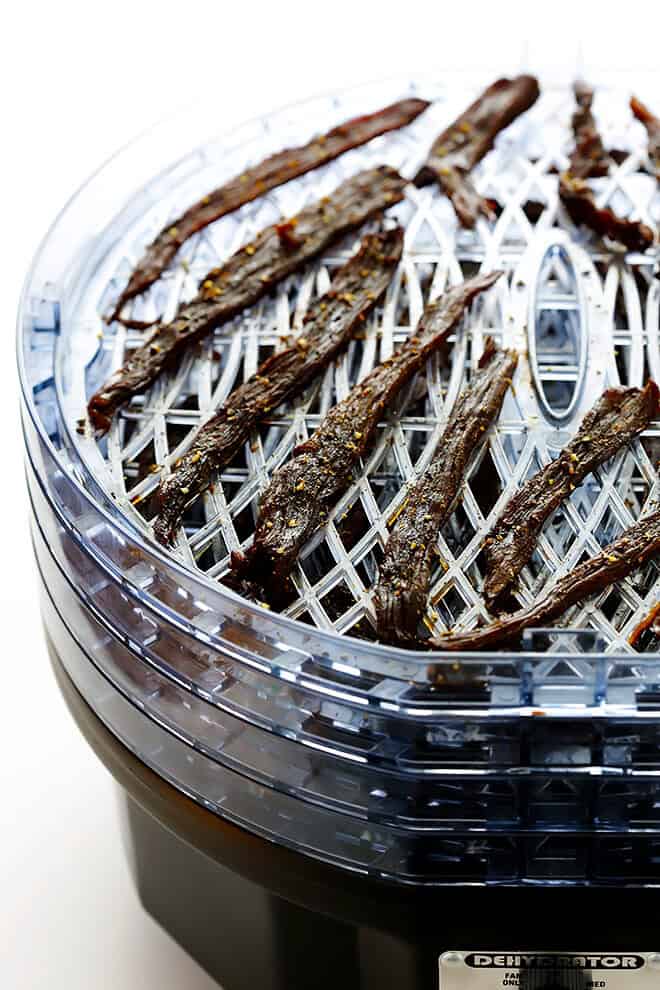
Ok, my heart is seriously pounding as I’m writing this post because I get so dang excited giving people tips on making killer beef jerky! (<– So weird, I know, but don’t forget I’m also the girl who begged Santa for a dehydrator. #Perspective.) Here are some of my tips and answers to frequently-asked questions from friends:
Beef: The biggest question is probably what cut of beef to buy. I’ve made beef jerky with all different kinds, but my favorite the past few years has undoubtedly been flank steak. It’s definitely one of the priciest options, but it’s one of the leanest cuts and I love how it makes nice thin strips of beef jerky. Other great options are eye of round, top or bottom round, or London broil. Generally, I just recommend going as lean as possible, and trimming off any extra large sections of fat that you see.
When it comes to slicing the meat, I recommend slicing it about as thin as possible (1/8 to 1/4-inch thick). And then if you want a chewier jerky (which I weirdly like), slice the meat with the grain. And if you want a more tender jerky, slice the meat against the grain. You’re welcome to do this yourself at home (just pop the steak in the freezer for 15-20 minutes before slicing to help firm it up a bit). OR, chances are, the butcher behind the meat counter of your local grocery store would be happy to do it for you too. (<– Probably for free!)
Marinade: So, my biggest gripe with most store-bought beef jerky is that it is waaaayyyyy too sweet. I love my beef jerky nice and peppery and savory. So my marinade consists simply of soy sauce, worcestershire, black pepper, liquid smoke, onion powder, seasoned salt, and garlic powder. And then for those of you who love pepper as much as I do, I highly recommend cracking some extra black pepper on top of the strips once you have laid them out to cook. The pepperier, the better if you ask me.
If you do happen to like sweeter beef jerky, just add 1/4 cup of maple syrup to the marinade. And if you like a spicier beef jerky, I recommend sprinkling some crushed red pepper flakes on top of the jerky as it cooks.
Dehydrator vs. Oven: Probably the main question I hear from friends is how to make beef jerky without a dehydrator. It’s totally possible in the oven. But in order for it to cook evenly, I recommend laying the jerky out on wire racks that are placed on top of foil-covered baking sheets. I know that some people like to just lay the jerky out directly on the oven racks themselves, and then place a sheet of aluminum foil on the bottom of the oven to catch the dripping juices, but I’ve tried it and — heads up — it’s messy. So instead, I recommend the wire rack method.
But that said, I still think cooking beef jerky in the dehydrator yields the most consistent and best results. I’ve owned 2 different dehydrators, and will say that the technology has improved significantly over the years. For between $35-75, you can purchase an awesome dehydrator nowadays that will cook the jerky evenly and quickly. And of course, you can also use the dehydrator to make all kinds of fruit and veggie and kale chips, and all sorts of other good stuff. So if you happen to love beef jerky as much as I do, I would totally recommend the Cuisinart dehydrator that I currently own.
Anyway, go with whatever cooking method works best for you! I’ve included instructions for oven and dehydrator beef jerky in the recipe below.
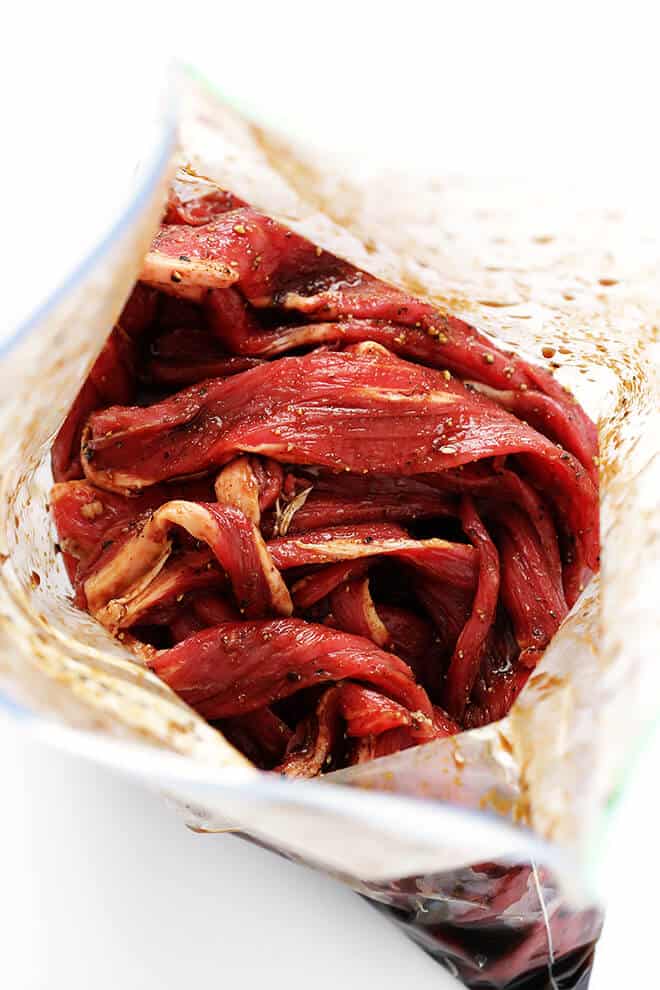
So all that said, to make your beef jerky, just toss the sliced beef and the marinade together in a large ziplock bag until the beef is evenly coated. Then pop the bag in the refrigerator for at least 30 minutes or up to 1 day to let those flavors sink in.
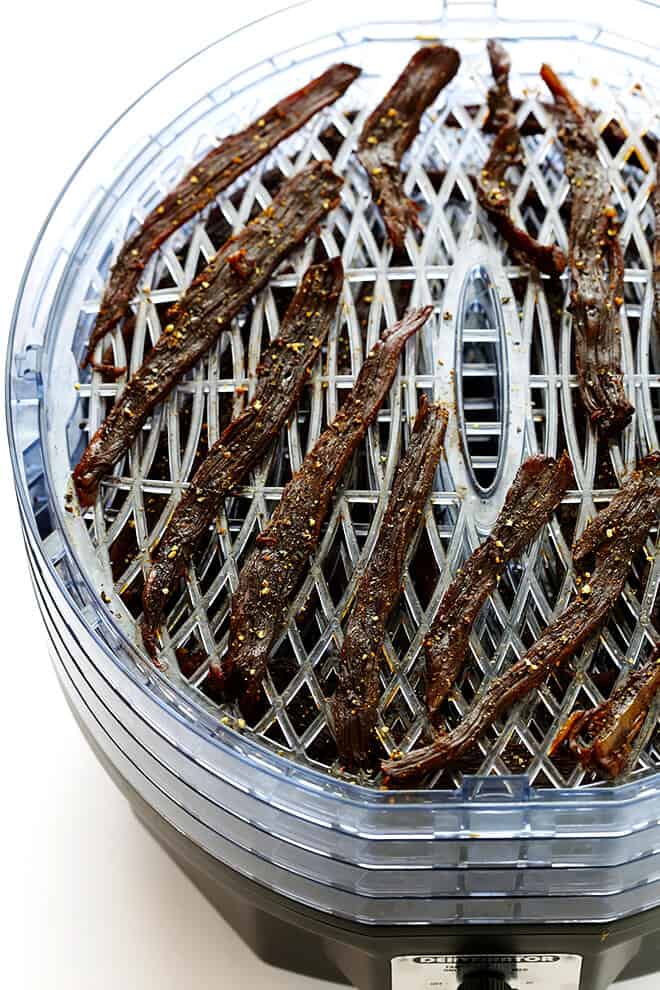
Then lay the strips out in an even layer on your dehydrator trays, or your wire-rack trays in the oven, and cook according to the instructions below. (Fair warning — this is going to absolutely fill your home with the most irresistible smell of jerky ever!)
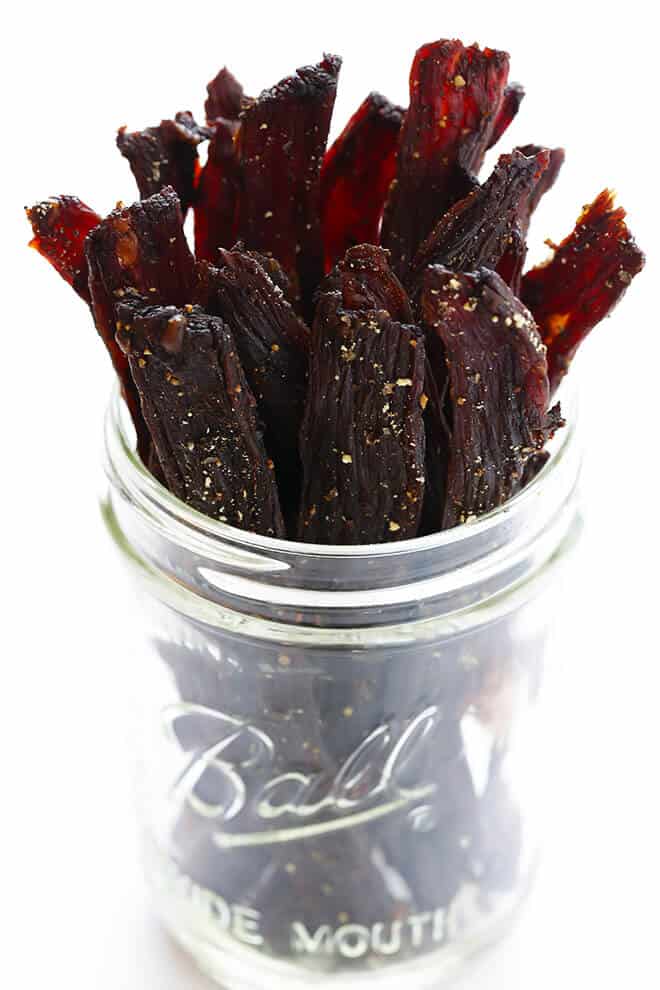
And then once the jerky reaches your desired level of dryness (I like mine really dry, but as long as it is cooked and dark and just slightly pliable, it should be good to go) — the BEST batch of beef jerky will be yours to enjoy and share!
Well, props to you if you make it to the sharing, because I tend to want to hoard this stuff. ;) But I am convinced this beef jerky makes the world a better place, so be generous if you can.
Enjoy, everyone!!
Beef Jerky
Equipment
Ingredients
- 2 pounds flank steak (or eye or round or top round steak)
- 1/2 cup low-sodium soy sauce
- 2 tablespoons worcestershire sauce
- 2 teaspoons coarsely-ground black pepper
- 1 teaspoon liquid smoke
- 1 teaspoon onion powder
- 1 teaspoon seasoned salt
- 1/2 teaspoon garlic powder
Instructions
- Thinly-slice the steak into 1/8-inch thick strips, either with the grain (which will result in a chewier beef jerky) or against the grain (which will be more tender). I recommend popping the steak in the freezer for 15-30 minutes before slicing so that it is easier to cut. (Or the butchers working behind the meat counters at most grocery stores will also do this for you if you ask.)
- Transfer the strips of steak to a large ziplock bag*.
- In a separate small mixing bowl, whisk together the remaining ingredients until combined. Pour the mixture into the ziplock bag with the steak, seal the bag, and toss until the steak is evenly coated.
- Refrigerate for at least 30 minutes, or up to 1 day.
- If you’re making the jerky in a dehydrator, lay the strips out in a single layer on the trays of your dehydrator. Then follow the dehydrator’s instructions to cook the beef jerky until it is dry and firm, yet still a little bit pliable. (With my dehydrator, that meant cooking the jerky on medium heat for about 8 hours. But cooking times will vary based on the thickness of your meat, and the heat/brand of your dehydrator.) Remove jerky and transfer to a sealed container. Refrigerate for up to 1 month.
- If you’re making the jerky in the oven, heat oven to 175°F. Adjust the racks to the upper-middle and lower-middle positions. Line two large baking sheets with aluminum foil, and place wire cooling racks on top of each sheet. Lay the strips out in a single layer on the wire racks. Bake until the beef jerky until it is dry and firm, yet still a little bit pliable, about 4 hours, flipping the beef jerky once about halfway through. (Cooking times will vary based on the thickness of your meat.) Remove jerky and transfer to a sealed container. Refrigerate for up to 1 month.
Notes
 Did you make this?Let me know how it turned out in the comments below!
This post contains affiliate links for the products I use and recommend. :)

I have to say this was by far the best beef jerky ive ever eaten and it didnt even last a day in my house!
Thanks for sharing such a fantastic and delicious recipe!!
I made this jerky in my dehydrator. It takes a little time but is REALLY GOOD. I used tri tip because it was what I had. I marinated for 4hrs.
Other people that tried it said it was tasty. My Mom asked if I really made it? I’m making it again…
Thank you SO much for the recipe. I have made it at least 4 times since September. I like that it’s not a sweet recipe, being a diabetic, but have used either extra garlic powder or extra black pepper. Can’t get enough.
This is very good with venison
Tried it with 2 pounds of eye of round and it was so good, so next day I did 6lb. Love it.
Thank you.
This sounds delicious! I would like to make some to send to a US base over seas. I see it needs to be refrigerated but I also see your response about silica packets. Can the packets be used in place of refrigerating? If not, do you have any suggestions on making it safe for shipping? Thanks!
I love jerky, and it is a way for me to get protein into my diet. I have problems with it getting in my teeth though. Is there a secret to make it where it does not do that so bad? Is my cut wrong? Am I cooking it too long?
Finally, a recipe without any additional sugar (or honey, maple, syrup, pineapple juice or any other source of sweetness). The bit of sweetness in the Worcestershire sauce is good enough for me. In fact, my least favorite flavor of beef jerky is teriyaki so this recipe is perfect (except for the smoke, which I’ve omitted because no one likes it around here). We made it in our oven size air fryer, which has a dehydrator function and 4 racks. The process took only 3-4 hours because air fryers have a powerful fan. Perfect.
My daughter uses this recipe, and now so do I, to make deer jerky, and it’s AMAZING! Here’s my question, is it possible to make jerky from ground meat?
Yes, you can but the texture is entirely different. It’s extremely tender because the meat fibers (aka grain) have been ground up. Basically, it’s like a hamburger vs a steak. Ground beef jerky will break up if you bend it. I’ve never made ground beef jerky but you’d basically use the same recipe, with no real need to marinate. That’s because there’s no need for the flavoring to penetrate the meat, or to tenderize the meat. You basically mix the meat as if you’re making meat loaf. You might need to adjust the wet ingredients because if the meat is too wet, it’ll be hard to mold. You then have to mold the meat into strips and dehydrate. Many people use a pastry bag to squeeze out strips of meat. You can get very inexpensive beef jerky kits on ebay which include a device for pumping out ground meat strips.
I am making tbe jerky in the oven at 170 degrees – it says to leave oven door open a crack..I did…it has been 3 hrs, the oven is not hot nor is tbe beef drying..we’re talking just open a crack. Just shut the oven door after 3 hrs – it showed it was less than 25 degrees…if I leave it closed it will cook and not dry – what to do. I am at almost 4 hrs – not drying!!!
Are you sure your oven is only 25F? That’s colder than a refrigerator. In fact, it’s freezing. That would be impossible in any home because you’d be dead if your home was that temperature. Perhaps you meant 25C? That’s 77F, which is room temperature. If that’s the case, it means that the oven never turned on. That could be the case if you have an electric oven. Many electric ovens won’t turn on unless the door is shut for safety reasons. If that’s the case, see if you can find a switch that the door hits when closed. You need to close the switch, usually with a piece of tape, to fool the oven thinking that the door was closed. Make sure to remove the tape after you’re done.
But no, 170F will not necessarily cook the beef. 170F would be the air temperature in the oven but the meat would be much cooler. Similarly, even though you roast a chicken at 350F, the chicken itself won’t even reach 165F for about an hour. If you must keep the door closed, just lower the temperature to maybe to 120F-140F or so and the beef will probably never exceed 110F, even after hours.